
Greek vs Turkish Coffee Brewing: Key Differences in 2026
Your coffee pot isn’t a political statement. Most baristas claim these two styles are identical. They’re wrong. While both cultures share a common ancestor in the Ottoman Empire’s coffee traditions, the subtle difference between greek coffee and turkish coffee brewing methods defines the soul of each cup. One focuses on a dark, intense extraction. The other prizes a lighter, golden foam. You can’t just swap a briki for a cezve and expect the same results.
It’s about the roast. It’s about the sugar timing. Greek coffee culture favors a milder, fruitier bean profile. Turkish traditions lean into bold bitterness and spice. If you think the only difference is the name on the menu, you’re missing the nuance of the grind and the heat. Let’s look at why these nearly identical pots produce such distinct experiences.
What are the key takeaways for coffee lovers?
- Grind Consistency: Both require a powder like flour, but Greek grinds are often even finer than Turkish ones to ensure rapid suspension.
- Roast Profile: Greek beans are usually lighter or medium roasted, whereas Turkish beans are traditionally darker and more robust.
- Sugar Status: In Turkey, you must decide your sugar level before brewing. In Greece, you have a bit more flexibility, though traditionalists still add it to the cold water.
- Equipment Names: The Greek pot is a briki and the Turkish pot is a cezve or ibrik.
- The Foam Factor: Greek coffee emphasizes a thick kaimaki (foam), while Turkish coffee often involves multiple boils to deepen the flavor.
How do the roast and bean selection differ?
Coffee starts with the bean. In Greece, you’ll mostly find 100 percent Arabica beans. These beans are roasted to a light or medium blonde color. This creates a flavor profile that is acidic, bright, and slightly floral. You won’t find oily, dark beans in a traditional Greek briki. It’s a cleaner taste overall. But it’s delicate. You have to watch the heat carefully or you’ll burn those bright notes away.
Turkish coffee takes the opposite approach. It relies on a darker roast that pushes toward bittersweet chocolate and earthy tones. Sometimes, a small amount of Robusta is blended in for extra body and caffeine. This makes the coffee feel heavier on the tongue. It stands up better to high heat. But it also carries a more intense bitterness that defines the Turkish experience. You can taste the fire in a Turkish cup.
The roast choice also dictates how the coffee interacts with water. Light roasted Greek beans absorb water differently. They stay suspended in the liquid longer. Darker Turkish beans create a more sediment heavy cup. This affects the clarity of the drink. And it changes how the foam forms at the top. The difference between greek coffee and turkish coffee brewing methods begins long before the water touches the flame.
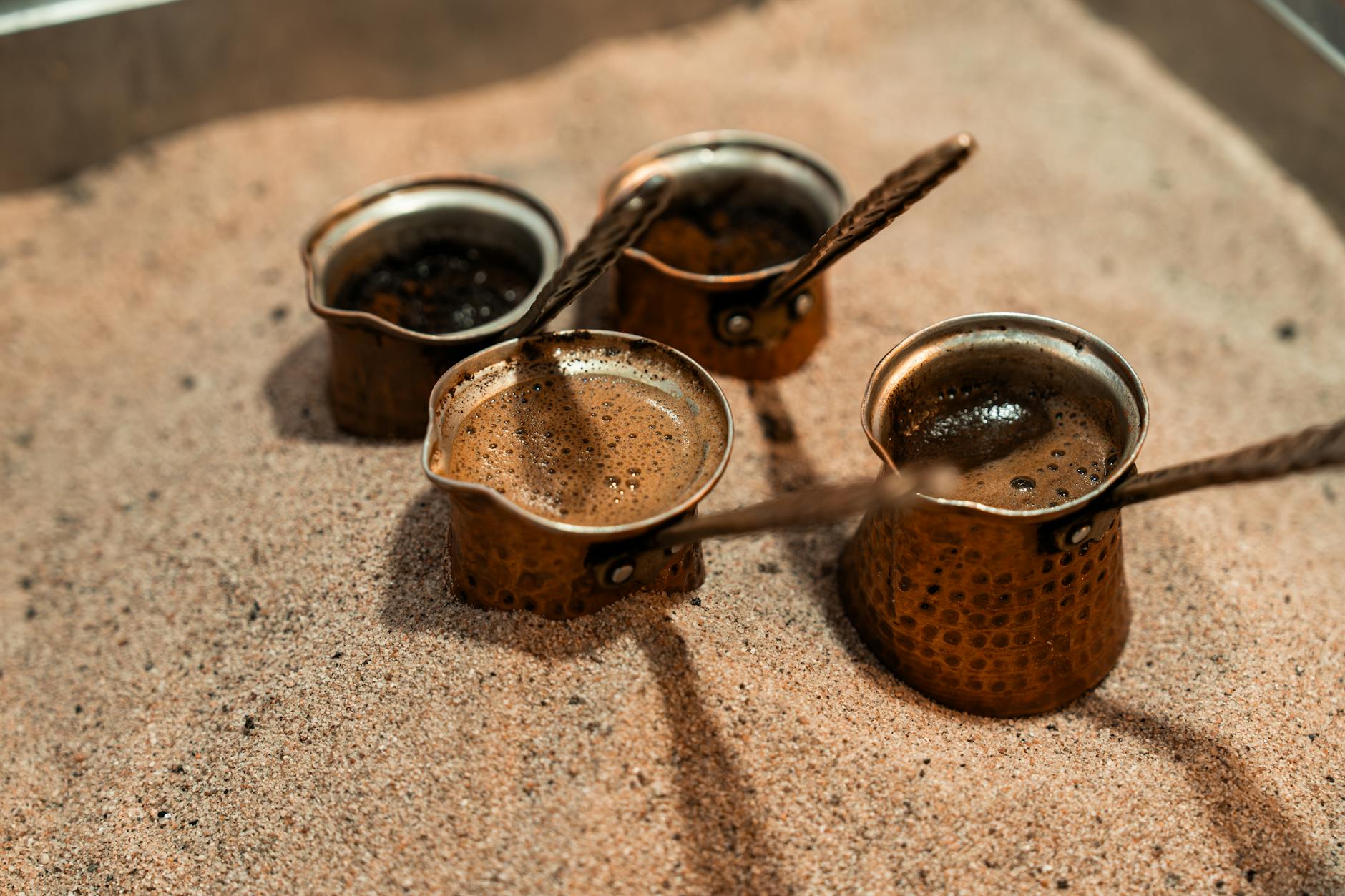
What is the difference between a briki and a cezve?
Tools matter deeply here. The Greek briki is typically made of brass or stainless steel. It has a slightly wider opening compared to its Turkish cousin. This shape allows the foam to expand more freely. It’s designed for a single or double portion. Greeks value the aesthetics of the pot. But it’s a functional piece of kit first. You’ll see them hanging in every kitchen from Athens to Thessaloniki.
The Turkish cezve is a masterpiece of thermal engineering. It usually features a very narrow neck and a wide bottom. This design concentrates the heat at the base. It also traps steam and pressure to force the foam upward through that narrow throat. This creates a denser, more concentrated head of bubbles. Copper is the preferred material in Turkey. It conducts heat with incredible precision. But it requires a tinned lining to keep the coffee safe from metallic tastes.
Can you use one for the other? Yes. But the results will shift. A narrow cezve might stifle the airy kaimaki of a Greek blend. A wide briki might fail to produce the thick, dark crema desired in an Istanbul coffee house. The equipment shapes the character of the brew. It’s not just about boiling water. It’s about managing surface area and pressure.
When do you add sugar in each method?
Sugar is a deal breaker. In the Turkish method, you must tell the host how much sugar you want before the pot hits the stove. It’s brewed directly into the water. This allows the sugar to caramelize slightly and bond with the oils in the coffee grounds. If you ask for sugar after the coffee is served, you’ll receive a polite but confused look. Stirring a finished cup ruins the sediment. It’s a cardinal sin in Turkey.
Greek culture is slightly more varied. Generally, you still add sugar to the cold water in the briki. There are four standard levels: sketos (plain), metrios (medium), glykos (sweet), and vary glykos (very sweet). However, some modern Greek cafes might offer sugar on the side. This is rare and usually signifies a more Westernized approach. The traditional difference between greek coffee and turkish coffee brewing methods remains the integration of sweetness during the heating process. It’s about a unified flavor.
The timing of the sugar affects the foam. Sugar increases the viscosity of the liquid. This helps the bubbles stay trapped in a thick layer. Without sugar, the foam is often thinner and dissipates faster. Both methods rely on this chemistry. But the Turkish commitment to pre-brewing sweetness is absolute. You choose your fate before the first bubble appears.
How does the boiling process vary between countries?
Controlled heat is the secret. In a Greek kitchen, the goal is a single, slow rise. You place the briki on a low flame or a hot sand bath known as a hovoli. You stir once to incorporate the grounds. Then you wait. As the coffee warms, the kaimaki begins to rise. You must remove it from the heat the exact second it reaches the rim. One boil is enough. But it must be perfect.
Turkish brewing often involves more drama. Some traditionalists prefer a double or triple boil. You let the foam rise, pour a little into the cup, and then return the pot to the heat. This process is repeated. It results in a much darker, much more extracted liquid. The multiple boils break down more of the coffee solids. It’s intense. But it can also lead to more bitterness if not handled by a master.
This difference between greek coffee and turkish coffee brewing methods alters the texture of the drink. Greek coffee feels more like a standard beverage with a creamy topping. Turkish coffee feels more like an elixir. It’s thick and almost syrupy. The multiple boils ensure that every bit of flavor is squeezed from the finely powdered beans. And that extra heat changes the chemical composition of the final cup.
Why is the kaimaki foam so important?
Foam is a sign of respect. In Greece, it’s the first thing your guest looks at. A cup without kaimaki is considered a failure. It means the coffee was boiled too long or the heat was too high. The foam should be thick, velvety, and cover the entire surface. It acts as an insulator. It keeps the coffee hot while you gossip and chat for an hour. But it also adds a creamy mouthfeel.
Turkish foam is equally vital. It’s called kopuk. Because of the darker roast and potential multiple boils, the Turkish foam is often darker and more bubbly. It carries the intense aroma of the roasted beans. In Turkey, the foam is often distributed among multiple cups using a spoon. This ensures everyone gets a fair share of the best part. No one gets left behind with a flat cup.
The bubbles are different too. Greek kaimaki is more about micro-bubbles that create a smooth surface. Turkish kopuk can have slightly larger, more robust bubbles. This is due to the darker oils present in the dark roasted beans. Both cultures judge the brewer by the quality of this top layer. If there’s no foam, there’s no hospitality. It’s that simple.
How do you serve and drink these coffees?
Slow down and wait. Neither of these coffees is meant for a traveler’s mug. You serve them in small cups called demitasse or flandzani. A glass of cold water is mandatory. You sip the water first to cleanse your palate. Then you wait for the grounds to settle at the bottom. The difference between greek coffee and turkish coffee brewing methods becomes clear as you watch the sediment. If you drink too fast, you’ll get a mouthful of mud.
In Greece, the coffee is often accompanied by a loukoumi (Turkish delight) or a small biscuit. It’s an afternoon ritual. People sit for hours in a kafeneio. They talk politics and play backgammon. The coffee is just the fuel for the conversation. You never stir it once it’s poured. The grounds stay at the bottom. But they’re useful later for fortune telling.
Turkish service is equally ceremonial. It often comes with a piece of chocolate or a traditional sweet. In some regions, a drop of pomegranate syrup or a side of dates is common. The focus is on the intensity of the moment. Turkish coffee is a tool for diplomacy and marriage proposals. It’s a serious business. The way you receive and drink the cup reflects your character.
Which method produces a stronger flavor?
Strength is subjective here. If you mean caffeine, they’re roughly the same because of the sheer volume of grounds used. However, the Turkish method feels stronger. The darker roast and multiple boils create a punchier flavor profile. It hits the back of your throat with a smoky, bitter edge. It’s the ultimate wake up call. But it can be overwhelming for those used to filtered coffee.
Greek coffee is more about nuance. The lighter roast preserves the acidity of the Arabica beans. You can taste the origin of the coffee more clearly. It’s smoother. It’s easier to drink without sugar. But don’t mistake smoothness for weakness. The difference between greek coffee and turkish coffee brewing methods doesn’t mean the Greek version lacks a kick. It just delivers it with a velvet glove instead of a direct punch.
The grind size also plays a role. Since Greek coffee is often ground to a literal powder, the extraction is incredibly fast. This can lead to a very rich body even without the multiple boils. Turkish coffee relies on the dark oils to provide that same sense of richness. Both are far stronger than your average espresso. They contain the entire bean, after all. You’re drinking the soul of the coffee.
How does the history of the region affect the names?
Names carry weight. Before the 1970s, many Greeks actually called their coffee Turkish. Political tensions, particularly the invasion of Cyprus in 1974, changed the branding overnight. It became a matter of national identity. The coffee didn’t change, but the name did. People started asking for Greek coffee to show their heritage. This is a classic example of culinary nationalism.
In Turkey, the name has been consistent for centuries. It’s simply Turk Kahvesi. Turkey takes great pride in their coffee being the first to be recognized by UNESCO as an Intangible Cultural Heritage. To them, the difference between greek coffee and turkish coffee brewing methods is a branch of their own ancient tree. It’s a point of pride. They see themselves as the masters of the cezve.
The Arab world also has its variations. They often use cardamom and different pot shapes. But the core Turkish and Greek styles remain the most famous. When you order one, you’re paying for a history lesson. You’re tasting a centuries-old rivalry and a shared love for the bean. The name might be a political choice. But the flavor is a cultural one.
Can you spice your coffee like a pro?
Spices are the divider. Traditional Greek coffee is almost never spiced. It’s purely about the coffee, the water, and the sugar. Adding cinnamon or cardamom would be seen as an oddity in an Athenian cafe. The goal is the purity of the bean. You want to taste the kaimaki and the subtle notes of the blonde roast. It’s a minimalist approach to flavor.
Turkish coffee is a different story. While many prefer it plain, cardamom is a very common addition. Sometimes you’ll find hints of mastic or even cloves. These spices are ground directly with the beans. This creates a complex, aromatic profile that is unique to the Eastern Mediterranean. It adds a layer of warmth and depth. It perfectly complements the dark, bitter roast profile.
Understanding the difference between greek coffee and turkish coffee brewing methods means knowing when to stay simple and when to experiment. If you want to honor the Greek tradition, keep the spice rack closed. If you want a Turkish adventure, a single pod of cardamom can change the whole experience. Just make sure the spice is as finely ground as the coffee. You don’t want chunks in your demitasse.
Master your morning brew with these steps
You don’t need a professional setup to get this right. Start with the freshest water possible. Use a ratio of one heaped teaspoon of coffee per demitasse cup. If you’re going Greek, find a light roasted Arabica powder. If you’re going Turkish, look for something darker and more robust. Don’t let the water boil too fast. Low heat is your best friend in this process.
Watch the pot like a hawk. The moment the foam starts to rise and move toward the center, lift it. If you’re making Greek coffee, pour it slowly into the cup to preserve the kaimaki. If you’re brewing Turkish style, try doing the double boil. Let it settle for at least two minutes. Or three. Your patience will be rewarded with a clear, intense drink that beats any pod machine on the market.
The difference between greek coffee and turkish coffee brewing methods is found in these tiny movements. It’s in the way you hold the handle. It’s in the way you watch the bubbles. Practice makes perfect. Don’t be discouraged if your first few cups are flat. Even the best grandmothers in the Aegean had to start somewhere. Keep brewing until you find your perfect cup.
Frequently Asked Questions
Is the grind for Greek and Turkish coffee the same?
Almost. Both must be an extra-fine powder. However, some professional Greek grinders produce a slightly more dusty consistency to help the lighter roast suspend better in the water. Turkish grinds are very similar but can sometimes be a fraction coarser to handle the longer boiling times.
Can I make these types of coffee in a regular percolator?
No. These methods are unfiltered. A percolator or drip machine cannot handle the flour-like grind. It would clog the filters and produce a muddy, over-extracted mess. You need a briki or cezve to do this properly.
Why does the coffee have so much sediment at the bottom?
Because the coffee is never filtered. The grounds stay in the cup. This is why the grind must be so fine. If the grounds were larger, they would be crunchy and unpleasant. The fine powder settles into a thick paste at the bottom. But don’t drink the paste.
Is there more caffeine in these coffees than in espresso?
Ounce for ounce, yes. Because you’re consuming more of the coffee oils and tiny particles that remain in the liquid, the caffeine hit is more immediate and intense. A double Greek or Turkish coffee will likely have more kick than a standard double espresso. It’s a concentrated experience.
What is the sand bath method used for?
The sand bath, or hovoli, provides the most even heat distribution. It allows the brewer to bury the pot in hot sand, heating it from all sides simultaneously. This results in a much thicker and more stable foam. It’s the gold standard for both methods in traditional settings.